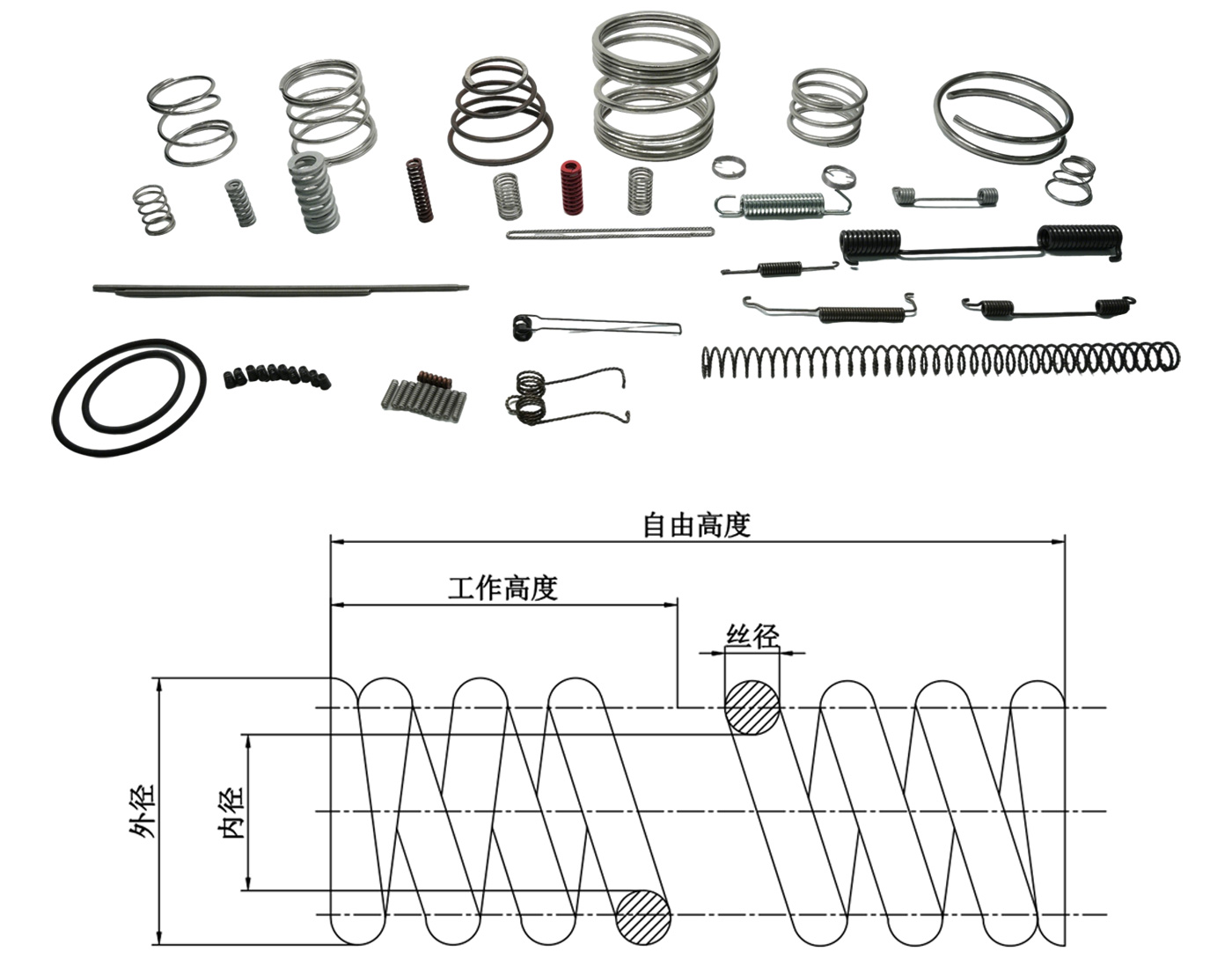
A coil spring, also known as a traditional spring, is a mechanical component made by winding a flexible metal round wire (or rod) into a spiral shape. Its basic principle is to utilize the elasticity of the material and the spiral structure to undergo significant elastic deformation when subjected to load, thereby absorbing energy, storing it, and releasing it upon unloading. Generally, coil springs are classified into compression, tension, and torsion springs based on their application functions.
Our company can customize spiral springs with various parameters according to customer requirements
Helical springs have core advantages such as strong shock absorption capacity, compact structure, convenient manufacturing, and stable stiffness.
As a widely used elastic element in modern mechanical systems, the helical spring exhibits its advantages primarily in the following aspects:
Strong shock absorption capability, enhancing comfort
Coil springs can effectively absorb road shocks and vibrations, and are widely used in automotive independent suspension systems, significantly improving the smoothness of vehicle travel and ride comfort. Due to the independent movement of each wheel, the vehicle body has greater stability
Compact structure, high space utilization
Compared to leaf springs, coil springs occupy less longitudinal space, are flexible to install, and are suitable for modern vehicle designs that have high space requirements. Their simple structure makes them easy to integrate into complex mechanical systems
Stable stiffness and precise adjustment performance
The cylindrical spiral spring exhibits linear characteristics, with a direct proportional relationship between load and deformation, and stable stiffness. It is suitable for applications requiring precise control, such as dynamometers and vending machines. By adjusting the wire diameter, number of coils, and pitch diameter, the stiffness can be flexibly adjusted
Easy to manufacture, low cost
The spiral spring is manufactured using either cold rolling or hot rolling processes, which are mature technologies with high production efficiency, making them suitable for large-scale applications. The material is mostly spring steel, which is widely sourced, economical, and practical
Lightweight, no lubrication required
The spring itself has a small mass, requires no lubrication, is resistant to dirt and mud, and has low maintenance costs, making it suitable for use in harsh environments
High energy utilization rate
It excels in energy storage and buffering, and is widely used in scenarios such as mechanical buffering, energy storage, and motion control